TeardownOct 2026Solo project
Energy Bill Extractor
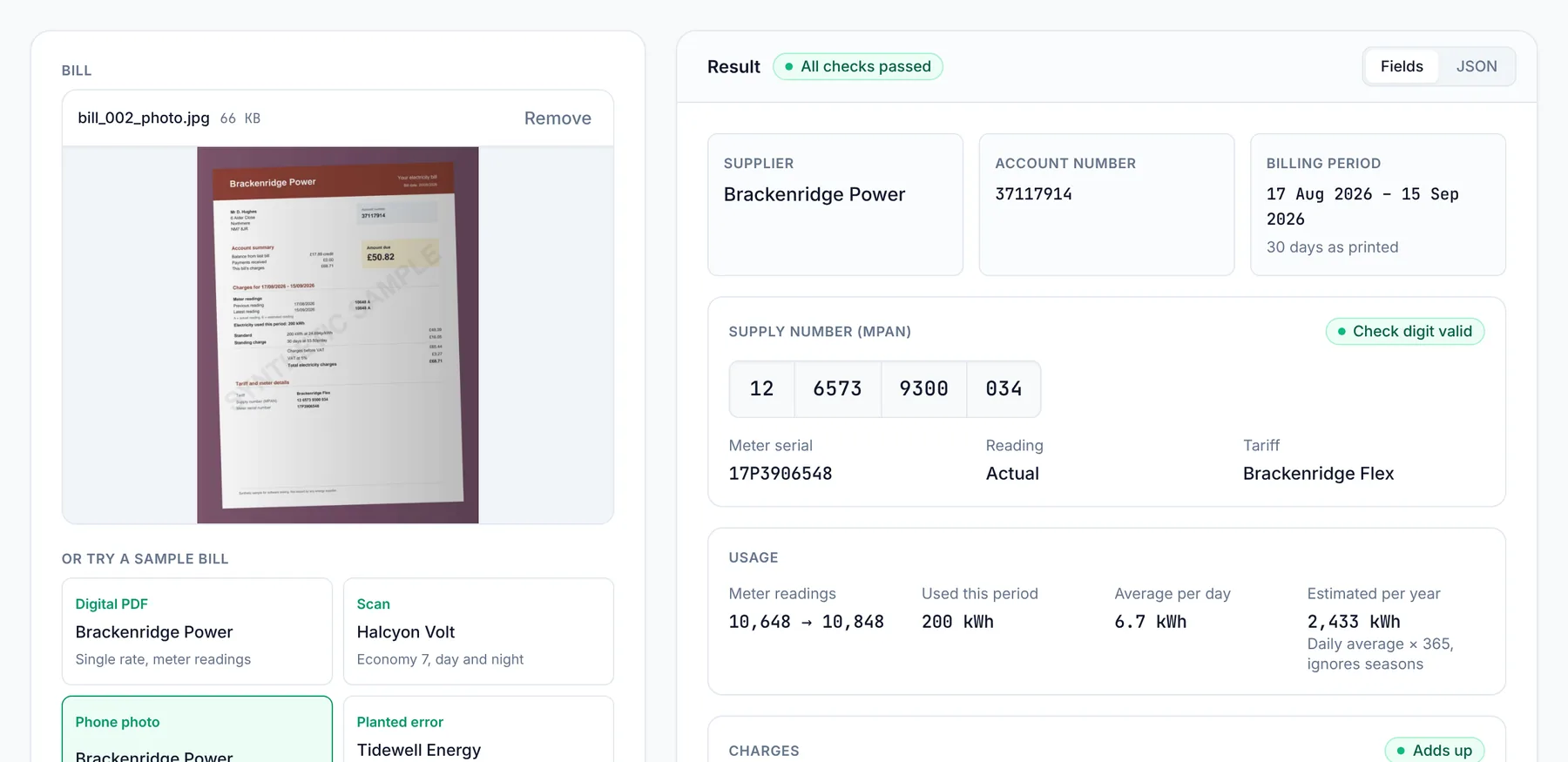
Upload an electricity bill as a PDF or a phone photo and get checked JSON back. The vision model only reads. Plain code does the maths.
- field accuracy on damaged phone photos
- 97.5%
- bills with a planted error caught
- 36/36
- per bill, about 2.6 s each
- $0.013
Plant an error
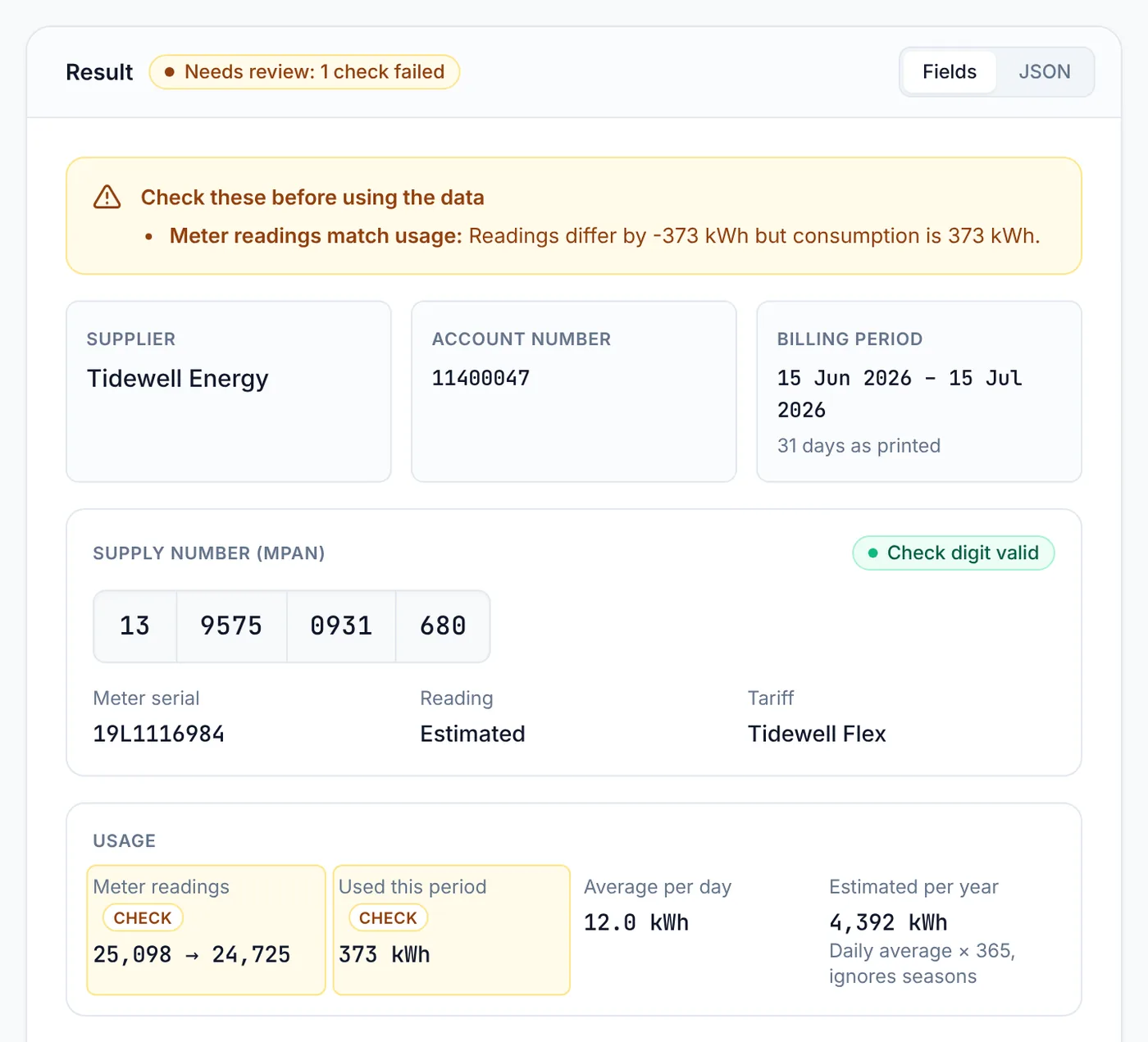
These are the fields a model read from one of the project's synthetic bills. Edit any value, or plant one of the errors from the evaluation, and the checks re-run in your browser, including the real MPAN check-digit algorithm.
Tidewell Energy
Synthetic sample. What the model read, field by field.
Plant an error from the evaluation:
All checks passed
8/8- Passed: MPAN check digitCheck digit is valid.
- Passed: Billing period matches its dates31 days.
- Passed: Meter readings match usage25098 − 24725 = 373 kWh.
- Passed: Energy charge = usage × unit rate£88.70.
- Passed: Standing charge = days × daily rate£16.54.
- Passed: Charges add up£105.24 before VAT.
- Passed: VAT is 5% of the subtotal£5.26.
- Passed: Total = subtotal + VAT£110.50.
{
  "needs_review": false,
  "flagged_fields": [],
  "checks_passed": "8/8"
}
8 of the project's 11 checks, running in your browser.
The problem
Switching energy supplier means copying a supply number, tariff, unit rates and usage off an old bill. A model can read the bill, but one misread digit quietly mis-prices a customer.
How I built it
The model copies each field exactly as printed, or null if it isn't there. It never does arithmetic.
Code does the rest: unit conversion, reconciling charges, meter readings and totals, and the MPAN check digit. Eleven checks in all. Any failure sets needs_review and names the fields a person should look at.
A strict Pydantic schema with one repair attempt, retries with backoff, and input guards. The file type comes from its bytes, damaged PDFs and decompression bombs are rejected, and bill contents never reach the logs.
The model provider is one environment variable: Claude, any OpenAI-compatible API, or a local model through Ollama.
What happened
- Claude Sonnet 5.5: 100% field accuracy on clean PDFs, scans and photos, and 97.5% across 96 photos from clean to severely damaged. About 2.6 s and $0.013 per bill.
- Haiku 5.5 caught 36 of 36 bills with a planted error, at about $0.0008 per bill.
- A local Qwen2.5-VL 3B reached 88.4% at no cost, which shows where the line is.
- What the checks miss: a misread name or an omitted optional field. 67% of the models' own errors were flagged, with no false alarms.
- More than 200 tests that run without a network. Evaluated on synthetic bills only, because real bills are personal data.
Architecture
- Python
- FastAPI
- Pydantic
- Vision LLMs
- Ollama
- Docker
- GitHub Actions
Next teardown
evalX
pytest for AI behaviour